
Start with an individual assessment
There is no single treatment plan that fits everyone. A licensed clinician can consider substance use, withdrawal risk, physical and mental health, living environment and personal goals. Availability, travel and insurance also affect practical choices.
Understand the main levels of care
Programs differ in medical capability and time commitment. Ask what services are included, rather than choosing by a program label alone.
- Detox: withdrawal management, with medical care when clinically needed.
- Inpatient or residential treatment: care in a setting where the person stays overnight. Medical services vary by program.
- Partial hospitalization (PHP): a structured day program with a substantial treatment schedule; participants generally return home or to separate housing.
- Intensive outpatient (IOP): scheduled treatment sessions while living outside the program.
- Outpatient counseling: appointments that may work alongside employment, family responsibilities or other care.
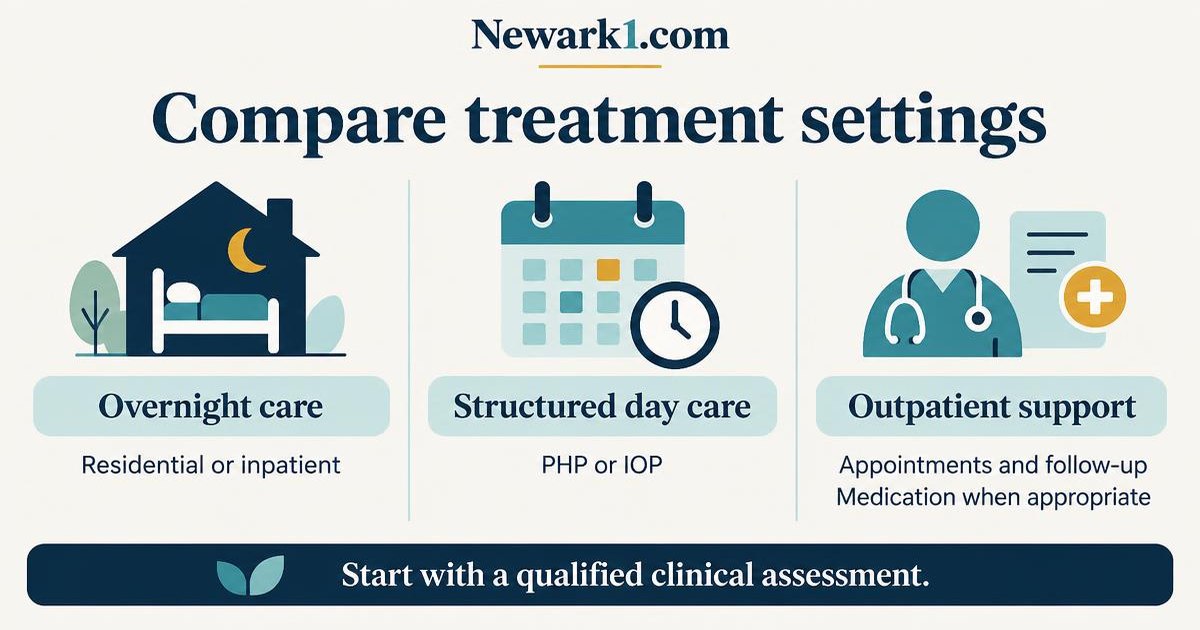
Compare treatment settings
- Overnight care: residential or inpatient; medical services vary.
- Structured day care: PHP or IOP; schedules and services vary.
- Outpatient support: appointments, follow-up and medication when appropriate.
- Start with a qualified clinical assessment.
Medications and behavioral health care
Medications can be part of evidence-based treatment for opioid or alcohol use disorder. This is sometimes called medication-assisted treatment. Ask a qualified prescriber which options are appropriate and how counseling and mental health needs will be addressed.
Recovery housing and family support
Recovery housing provides a substance-free living environment, but is not necessarily a clinical treatment program. Confirm housing rules, fees, medication policies and available support. Family education and peer support can complement treatment, without replacing clinical care.
Compare programs before committing
Confirm licensing, staff qualifications, medication access and continuing-care planning. Ask for total costs in writing and verify insurance with both the program and insurer. Consider transit, work schedules, language needs and family responsibilities when evaluating access from Newark.

Interactive Program Checklist
Your selections stay in this browser only. Nothing is submitted, sent, or tracked.
Frequently asked questions
How do I know which level of care is appropriate?
A clinical assessment is the starting point. Newark1.com cannot diagnose a condition or prescribe a level of care.
Is recovery housing the same as residential treatment?
Not necessarily. Housing and clinical treatment are different services. Ask who provides treatment and what oversight applies.
Can someone receive mental health and addiction care together?
Some programs address both. Ask how the program assesses and coordinates co-occurring mental health needs.
Sources & further reading
Newark1.com is an independent informational resource, not a treatment center, detox, hospital, emergency service, or government agency. Information is educational and is not medical or legal advice.