
Key takeaways
There is no dependable smell that identifies cocaine. Reported odors range from almost none to chemical or burnt-plastic smells, and none prove what a substance is, how strong it is or whether it contains fentanyl. Never sniff, taste or burn an unknown powder. A family can ask for help without first proving which substance was used.

Does powder cocaine have a smell?
Powder cocaine has no distinctive odor that a person can use to confirm what it is. Street samples may contain other compounds, and descriptions such as “chemical,” “sweet” or “medicinal” are subjective. They cannot tell cocaine apart from another substance.
| Reported observation | Important limitation | Practical response |
|---|---|---|
| Little or no noticeable odor | Does not identify a powder or show it is safe | Leave the substance undisturbed |
| Chemical or fuel-like smell | Many household products smell similar | Do not assume a particular drug is present |
| Acrid or burnt-plastic smell | Not specific to crack; may have other sources | Consider fire or chemical hazards too |
| Sweet or perfumed smell | Does not show ingredients, strength or purity | Never use scent as a safety check |
Hour ranges follow the ASAM Criteria; individual programs vary.
What does crack smoke smell like?
Some accounts describe crack smoke as sharp, acrid or like burning plastic or rubber. These are impressions, not a way to identify a substance. A burning smell can also come from an electrical fault or household materials. If there is smoke, a possible fire or a breathing hazard, move to safety and call 911. Do not inhale fumes to investigate.
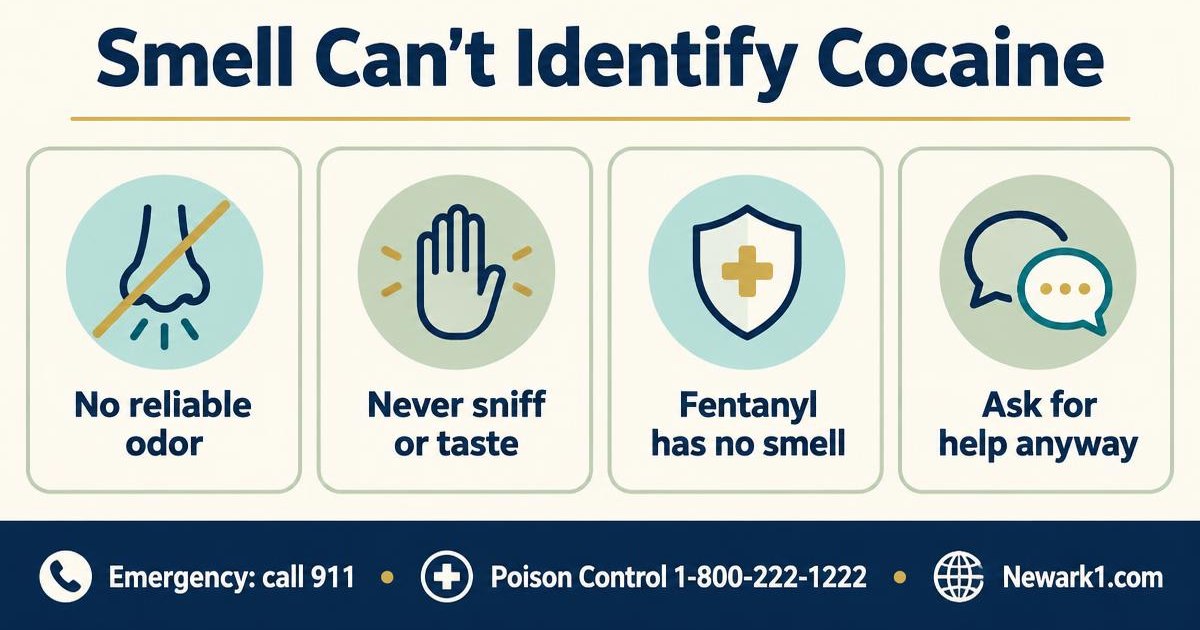
Smell can’t identify cocaine
- There is no reliable cocaine odor.
- Never sniff, taste or burn an unknown powder.
- Fentanyl cannot be detected by smell.
- Families can ask for help without proof.
Why do people mention gasoline or chemical odors?
Illicit drugs can contain other volatile compounds, including manufacturing leftovers and added substances. But “smells like gasoline” is an observation, not a chemical analysis. It cannot tell you what a particular sample contains.
Can smell reveal purity or fentanyl?
No. Odor, color, shine or a street name cannot show purity or contents. The CDC explains that fentanyl cannot be detected by sight, smell or taste. Fentanyl test strips can show whether fentanyl is present, but a negative result does not mean a substance is safe.
Related: free naloxone in New Jersey
What about a smell on clothes or in a room?
An unfamiliar odor on clothing, in a car or in a bedroom does not prove cocaine use. Odors transfer from surroundings and have many explanations. Describe what you actually noticed—an odor, poor sleep, missed commitments—rather than turning one observation into a conclusion.
What to do about an unknown powder
Leave it alone and focus on safety.
- Do not sniff, taste, burn or disturb it to find out what it is.
- Keep children and pets away, and avoid sweeping or vacuuming it into the air.
- Ask local authorities for advice on safe handling rather than collecting a sample.
- For a suspected exposure, call Poison Control at 1-800-222-1222.
- Call 911 for serious symptoms. Do not wait to identify the substance.
When it is an emergency
Call 911 for collapse, seizures, trouble breathing or chest pain after suspected drug use. If an opioid overdose is possible, give naloxone if available and follow the dispatcher’s directions. Naloxone reverses opioids; it does not reverse cocaine itself, but street drugs may contain fentanyl.
Raising a concern without accusing someone
Start with an observation and an invitation to talk, for example: “I noticed something unfamiliar and I am worried about your safety. Can we talk about what is happening?” Choose a calm moment, do not demand a confession and explain what support you can offer. If a conversation becomes unsafe, step away and seek help.
Related: planning a supportive conversation · support for Newark families
Where Newark families can find help
ReachNJ (1-844-732-2465) is New Jersey’s substance use help line, including for families looking for guidance. When you talk with a provider, ask about assessment, the recommended level of care, staff credentials, insurance and out-of-pocket costs, and how mental health and use of more than one substance will be evaluated.
Related: addiction treatment options in Newark · free and low-cost help

Frequently asked questions
Does no smell mean an unknown powder is harmless?
No. The absence of an odor does not identify a substance or show that it is safe. Leave an unknown powder alone and seek guidance.
Does a gasoline smell prove cocaine is present?
No. Fuel and solvent-like odors have many possible sources. Smell cannot show whether cocaine is present, how strong it is or what else it contains.
Should I taste a powder to see whether it causes numbness?
No. Tasting exposes you to an unknown substance and is not a reliable test. For a suspected exposure, call Poison Control at 1-800-222-1222.
Can you smell fentanyl in cocaine?
No. The CDC says fentanyl cannot be detected by sight, smell or taste. Call 911 for any suspected overdose and give naloxone if available.
Can I ask for help if my family member denies using drugs?
Yes. You can share your own observations and concerns with a counselor or ReachNJ without first proving substance use.
Sources & further reading
How this page was researched: drafted from the official sources listed above and checked against them. Read our editorial and sourcing approach.
Newark1.com is an independent informational resource, not a treatment center, detox, hospital, emergency service, or government agency. Information is educational and is not medical or legal advice.