
Key takeaways
Addiction care runs on a continuum from outpatient visits to medically managed inpatient care. Clinicians often use the ASAM Criteria to match a person to the least intensive setting that is safe and effective. People can step up or down between levels as needs change, and medication can be part of any level.

How the right level is decided
Clinicians assess withdrawal risk, medical and mental health needs, readiness, living environment and recovery supports before recommending a level of care. Many use the ASAM Criteria, the most widely used national standard for placement. The goal is the least intensive setting that is safe and effective for the person.
| Level | Where the person lives | Typical intensity | Often considered when |
|---|---|---|---|
| Outpatient | At home | Scheduled visits, usually less than 9 hours a week | Symptoms are stable and home is supportive |
| Intensive outpatient (IOP) | At home | About 9 to 19 hours a week | More structure is needed while keeping daily routines |
| Partial hospitalization (PHP) | At home or in separate housing | 20 or more hours a week, usually day programming | Daily structure is needed without overnight care |
| Residential | At the program | Around-the-clock structured setting | Home is not safe for recovery or outpatient care has not worked |
| Medically managed inpatient | At a hospital-level setting | 24-hour medical and nursing care | Serious medical or withdrawal risks need close monitoring |
Hour ranges follow the ASAM Criteria; individual programs vary.
Withdrawal management (detox)
Detox manages the physical process of withdrawal, with medical monitoring and medication when clinically needed. It can happen in outpatient, residential or inpatient settings depending on risk. Detox alone is not complete treatment; continuing care matters.
Related: detox resources in Newark
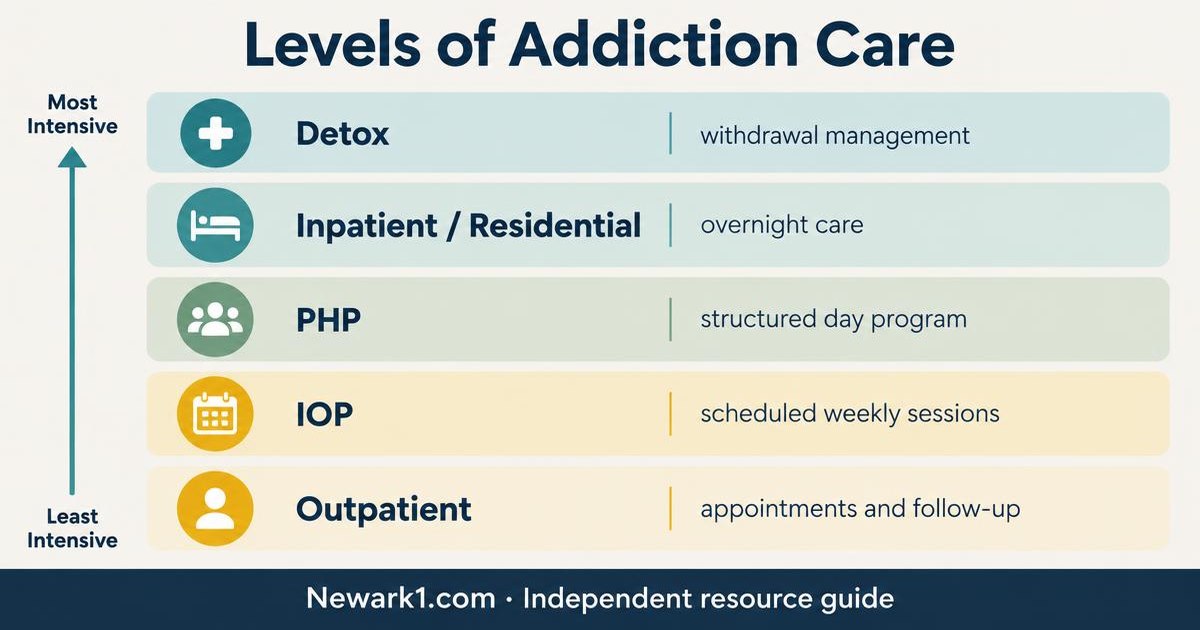
Levels of addiction care
- Detox: withdrawal management.
- Inpatient or residential: overnight care.
- PHP or IOP: structured day or weekly programs.
- Outpatient: appointments and follow-up.
Inpatient and residential treatment
The person stays at the program full time. Medical and clinical services vary widely between programs, so ask what is actually provided. This level is often considered when outpatient care is not safe or has not worked.
Partial hospitalization (PHP) and intensive outpatient (IOP)
PHP is a structured program of 20 or more hours a week; IOP generally involves about 9 to 19 hours a week. In both, the person lives outside the program. These levels can be a step down from residential care or a step up from weekly outpatient visits.
Medication at any level
Medications for opioid and alcohol use disorders can be part of care at every level, including outpatient. Ask any program whether it offers or coordinates these medications, and how it supports people who already take them.
Outpatient care and continuing support
Outpatient care includes regular counseling appointments and, where appropriate, medications for addiction treatment. Recovery support—peer groups, recovery housing and continuing-care planning—helps sustain progress after formal treatment ends.
Related: how to pay for each level of care

Frequently asked questions
Which level of care do I need?
Only a qualified clinical assessment can answer that. Clinicians consider withdrawal risk, health needs, environment and supports.
What are the ASAM Criteria?
They are national standards many clinicians and insurers use to match people to a level of care and decide when to move between levels.
What is the difference between PHP and IOP?
PHP generally involves 20 or more hours of treatment a week; IOP involves fewer. In both, the person lives outside the program.
Is a higher level of care always better?
No. The goal is the least intensive setting that is safe and effective. More intensive care is not automatically better care.
Can someone move between levels?
Yes. People commonly step up or step down between levels as their needs change during recovery.
Sources & further reading
How this page was researched: drafted from the official sources listed above and checked against them. Read our editorial and sourcing approach.
Newark1.com is an independent informational resource, not a treatment center, detox, hospital, emergency service, or government agency. Information is educational and is not medical or legal advice.