
Key takeaways
A suspected overdose is a medical emergency: call 911 right away. If opioids may be involved, give naloxone and stay with the person. New Jersey’s Overdose Prevention Act protects people who seek help in good faith from arrest and prosecution for certain drug possession offenses. Follow-up care after any overdose matters.

Call 911 first
A suspected overdose is a medical emergency. Call 911 immediately—do not wait, do not call a resource line first and do not assume the person will sleep it off. Give your exact location and describe what you can observe.
Signs of a possible opioid overdose
Warning signs can include unresponsiveness, slow or stopped breathing, blue or gray lips or fingertips, choking or gurgling sounds and pinpoint pupils. You do not need to be certain—if you suspect an overdose, call 911.
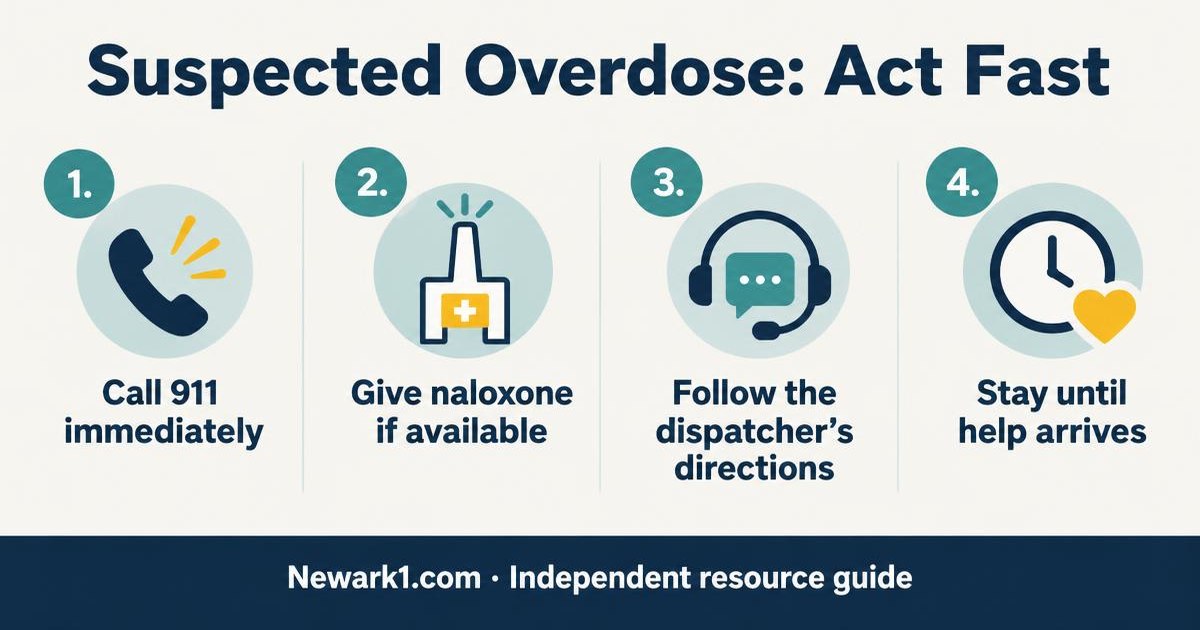
Suspected overdose: act fast
- Call 911 immediately.
- Give naloxone if available.
- Follow the dispatcher’s directions.
- Stay until help arrives.
Use naloxone if you have it
If opioid overdose is suspected and naloxone is available, use it according to its package instructions. Naloxone will not harm someone who has not taken opioids. Emergency medical evaluation is still required even if the person wakes up.
Related: where to get naloxone in New Jersey
Fentanyl and xylazine
The CDC reports that xylazine, a non-opioid sedative, is being found in the illegal drug supply, often mixed with fentanyl. Naloxone does not reverse xylazine, but the CDC advises giving naloxone whenever an opioid overdose is suspected, because opioids are often present. Always call 911.
While you wait for help
Follow the dispatcher’s directions. If the person is breathing but unresponsive, place them on their side to help keep their airway clear. Stay with them until emergency responders arrive, if it is safe to do so.
Calling 911 is protected
Under New Jersey’s Overdose Prevention Act (N.J.S.A. 2C:35-30 and 2C:35-31), a person who seeks medical help in good faith for a suspected overdose—and the person who overdosed—cannot be arrested, charged, prosecuted or convicted for certain drug use and possession offenses. It does not cover offenses such as drug distribution. Do not let fear delay a 911 call.
After the emergency
A nonfatal overdose is a critical warning sign. Ask the emergency care team about follow-up care, medications for opioid use disorder and overdose prevention. Reduced tolerance after a period without use increases the risk of another overdose.
Related: detox and next-step resources · more crisis and emergency resources

Frequently asked questions
Should I call 911 even if I give naloxone?
Yes. Naloxone can wear off before the opioids do, and emergency medical evaluation is still required. Always call 911.
Can I get in trouble for calling 911 during an overdose?
New Jersey’s Overdose Prevention Act protects people who seek help in good faith from arrest and prosecution for certain drug possession offenses.
Does the law protect the person who overdosed?
Yes. The law covers both the person who calls for help in good faith and the person experiencing the overdose, for the listed offenses.
Does naloxone work on xylazine?
No. But the CDC advises giving naloxone whenever an opioid overdose is suspected, because opioids such as fentanyl are often present.
What if I am not sure it is an overdose?
Call 911 anyway. You do not need to be certain—describe what you observe and let professionals assess.
Sources & further reading
How this page was researched: drafted from the official sources listed above and checked against them. Read our editorial and sourcing approach.
Newark1.com is an independent informational resource, not a treatment center, detox, hospital, emergency service, or government agency. Information is educational and is not medical or legal advice.